Stuart
- What
- A working prototype of Stuart — the community librarian agent — built in a weekend.
- Role
- Member of a great team. Mostly working on software.
- Span
- 2026 →
- Status
- completed
Stuart is what Community AI looks like when you build it in a weekend. The HARD MODE hackathon at MIT was the excuse to make something people could actually walk up to and use.
The premise, and the case for why an AI steward of a small community is worth building today, is laid out here.
What we built is a small library station with an agent living inside it. You tap an NFC card to authenticate, then drop off or request an item. A camera and Claude’s vision model work out what you’re putting in; a Postgres database keeps the inventory; ElevenLabs gives Stuart a voice, so the whole exchange happens out loud rather than through a screen. A servo handles the lock, a depth sensor notices when someone walks up, and addressable LED strips light up to point at where a requested item is sitting. A Raspberry Pi runs the firmware while a small FastAPI backend bridges the hardware to the cloud services. We deliberately kept it cloud-heavy, so we could iterate on Stuart’s personality and its recognition without reflashing the Pi every time.
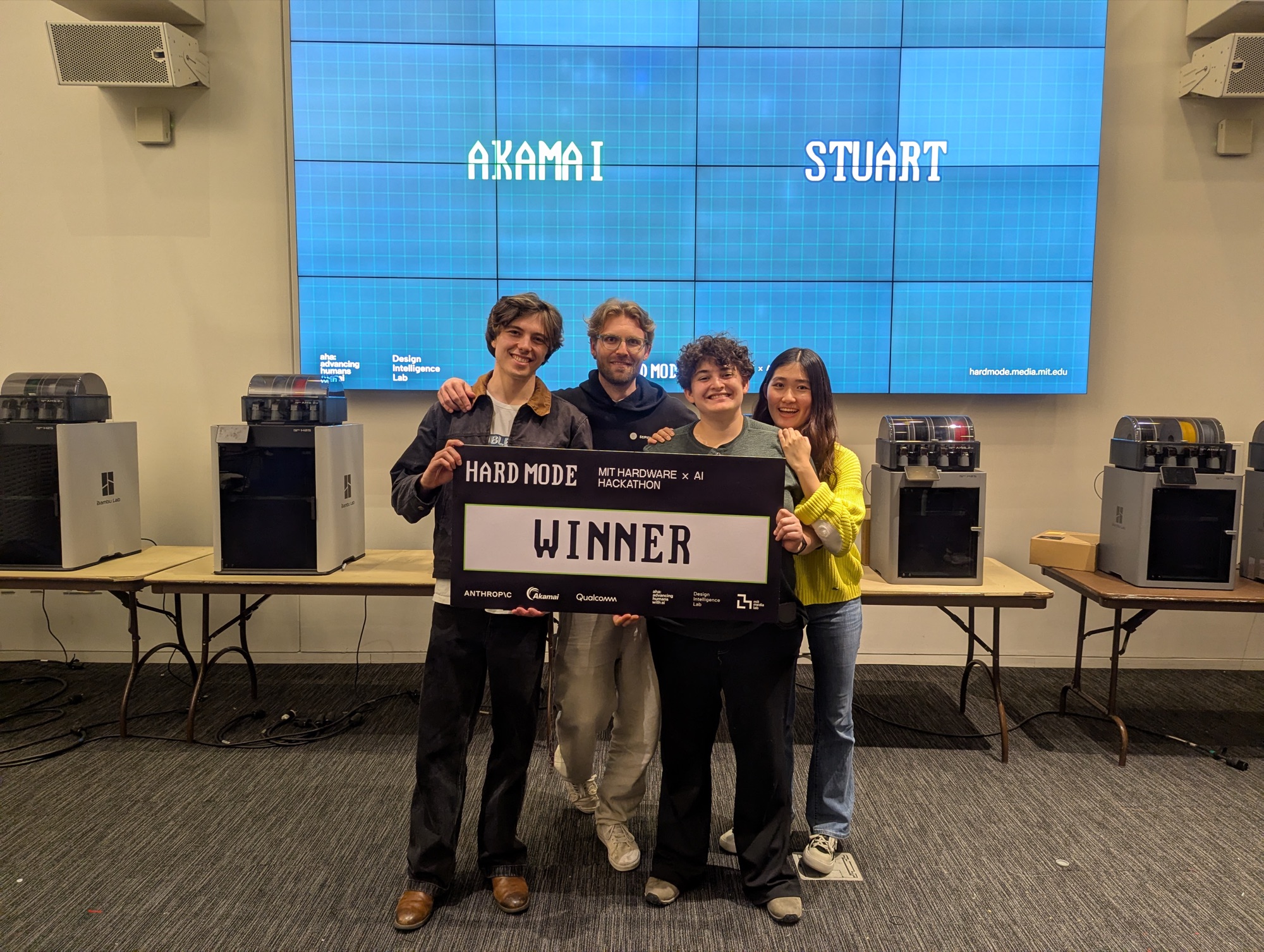
Not everything cooperated. The Bluetooth speaker fought us on the older Pi, item recognition was unreliable, and the demo floor challenged us with competing wifi devices and noise. It held together anyway. Stuart took the hackathon’s award in the Akamai track.
Built over the weekend with Max Holschneider, Cecilia Marsicovetere and Saetbyeol Leeyouk. The obvious next step is to put Stuart somewhere real. The Media Lab will be a good start, and then the kind of places it’s actually for like an apartment lobby, a co-working space or the corner of a neighbourhood park.